


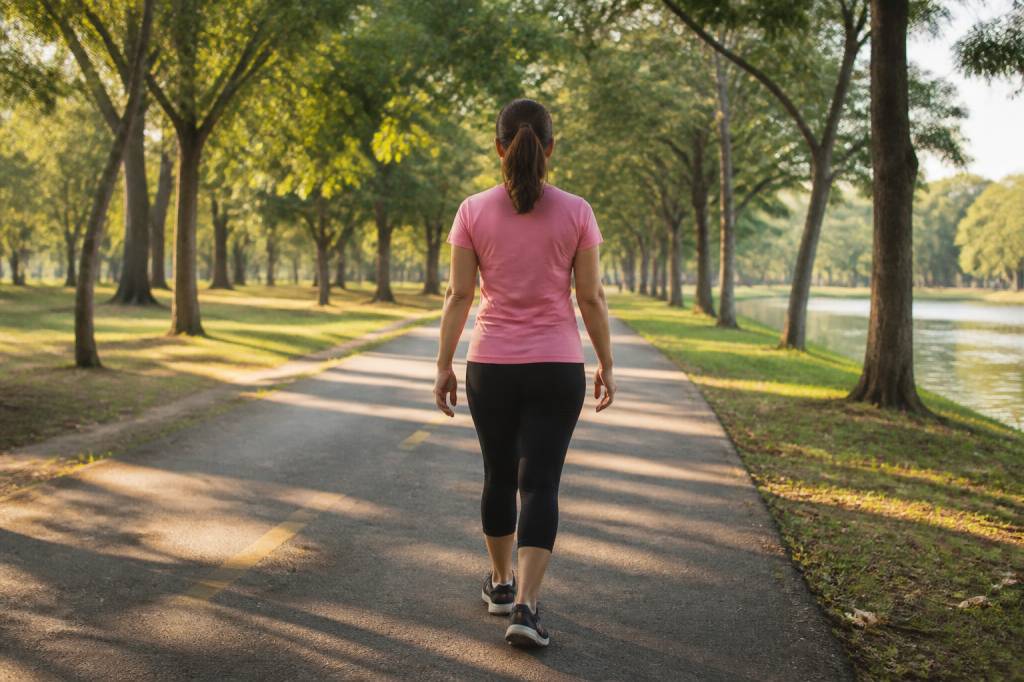
Ten thousand steps a day has become one of the most recognisable targets in health and fitness. It appears on smartwatches, office wellness charts and social media feeds, often presented as a simple rule for better health. But does it actually matter? And if so, how much?
The short answer is yes: daily walking is linked to better cardiovascular health, improved mood, more energy and, for many people, support with weight management. The longer answer is more useful. The benefits depend on how much you walk, how consistently you do it, and what you pair it with. Ten thousand steps is not a magic number, but it is a practical benchmark. For a lot of people, it is enough to make a meaningful difference without requiring a gym membership, expensive gear or a dramatic lifestyle overhaul.
That is part of why walking remains one of the most accessible forms of exercise. It is low-impact, low-cost and easy to adapt to nearly any schedule. The question is not whether walking works. It does. The question is how to make it work for you.
Why 10,000 steps became the benchmark
The 10,000-step target did not begin as a scientific rule. It became popular in Japan in the 1960s as part of a pedometer marketing campaign. The number was catchy, easy to remember and ambitious enough to motivate people. Over time, it became a global fitness shorthand.
That matters because the target is often treated as if it came from a medical guideline. It did not. But research over the past two decades has still shown that increasing daily step count is associated with real health benefits. In other words, the origin was commercial, but the results are backed by evidence.
Current studies suggest that the biggest gains often happen when people move from very low activity levels to moderate daily walking. You do not need to hit exactly 10,000 steps to benefit. For some adults, 7,000 to 8,000 steps may already provide much of the health payoff. Still, 10,000 remains a useful target because it encourages consistency and enough volume to make a difference.
The health benefits of walking more each day
Walking is not glamorous, but it is effective. It improves circulation, raises daily energy expenditure and helps regulate blood sugar. It also supports joint mobility and can reduce stiffness, especially for people who spend long hours sitting. That alone makes it a strong option for office workers, commuters and anyone whose day is built around a chair.
Research has linked higher step counts with lower risk of several chronic conditions. These include heart disease, type 2 diabetes and some forms of depression. Walking does not replace medical treatment, but it can be a meaningful part of prevention and long-term health maintenance.
There is also a mental health angle. A brisk walk can clear the head in a way that endless scrolling rarely does. It gives the brain a break, especially if the walk includes daylight and a change of scenery. That combination can help with stress and mood, and it is one reason many people find walking easier to stick with than more intense workouts.
Other practical benefits include:
- better sleep quality for many people
- improved balance and coordination over time
- more stable energy levels during the day
- less sedentary time, which matters even if you exercise elsewhere
- a lower barrier to entry than most other forms of exercise
The key point is simple: walking is not just “better than nothing.” For many adults, it is one of the most reliable habits for long-term health.
Can 10,000 steps help with weight loss?
Yes, but with an important caveat. Walking can support weight loss because it increases daily calorie burn, but it works best as part of a broader energy balance. If you walk 10,000 steps and then consistently eat more calories than you use, weight loss will stall. Biology is annoyingly consistent that way.
A person’s calorie burn from 10,000 steps depends on factors such as body weight, walking speed, terrain and stride length. For many adults, 10,000 steps may burn somewhere in the range of 300 to 500 calories, though the number can be higher or lower. A brisk pace, hills or carrying extra body weight will increase the burn.
For weight management, the more useful question is not “Does 10,000 steps burn enough?” but “Does it help create a sustainable routine?” In many cases, yes. Walking can support fat loss in three ways:
- it increases daily energy expenditure without making people ravenous the way intense exercise sometimes can
- it can improve insulin sensitivity, which helps the body manage blood sugar more efficiently
- it tends to be sustainable, so people are more likely to maintain it long term
That said, people often overestimate the effect of walking and underestimate the effect of food intake. A daily walk is helpful, but it is not an excuse to turn every lunch into a calorie event. If weight loss is the goal, walking should ideally sit alongside sensible nutrition, adequate protein and a realistic calorie deficit.
A useful practical example: if someone currently averages 3,000 steps a day and increases to 10,000, that is a substantial change. It can improve fitness, support weight control and reduce sedentary time. But if the same person also starts eating more because they feel they “earned it,” the progress may disappear. The walking still helps. The math just needs to be allowed to work.
How much walking is enough?
Ten thousand steps is a target, not a law. The right number depends on your current activity level, age, health status and goals. If you are already active, 10,000 may be a good maintenance target. If you are starting from a low baseline, the priority is to increase gradually and consistently.
Evidence suggests that stepping up from a sedentary routine to even a moderate amount of daily walking can produce meaningful benefits. In plain terms, the gap between 2,000 and 6,000 steps is often more important than the gap between 9,000 and 10,000.
For many people, a practical progression looks like this:
- start with your current average step count
- add 500 to 1,000 steps per day for a week or two
- increase again once the new level feels manageable
- focus on consistency before chasing a perfect number
This approach is less dramatic than an all-or-nothing target, but it is more realistic. And realistic habits tend to survive beyond the first enthusiastic week.
Daily walking tips that actually work
Getting to 10,000 steps is not usually about one heroic walk. It is about accumulating movement across the day. That makes the goal easier to reach and easier to sustain. The good news is that steps add up quickly if you stop treating movement as a single event.
Here are practical ways to build walking into a normal day:
- walk for 10 minutes after meals
- get off the bus or train one stop early
- take phone calls while walking
- use the stairs when it makes sense
- park slightly further away from your destination
- set a reminder to stand and move every hour
- walk during part of your lunch break instead of sitting the whole time
If you work from home, the challenge is different. It is easy to go from bed to desk to sofa with almost no movement in between. In that case, a short morning walk can set the tone for the day. A second walk after lunch helps break up long periods of sitting. Even a few five-minute bouts can make a noticeable difference when repeated consistently.
Pace matters too. Casual strolling still counts, but brisk walking usually delivers more benefits in less time. You should be able to talk, but not sing. If you are gasping for air, slow down. If you can comfortably recite a shopping list, speed up a little.
How to make walking more effective for fitness
If your aim is more than just step count, there are a few ways to improve the quality of your walks. Increasing intensity slightly can raise the cardiovascular benefit without making the session feel punishing.
Try these options:
- include hills or inclines
- walk at a brisker pace for short intervals
- carry a light backpack if appropriate and comfortable
- extend one or two walks each week into longer sessions
- combine walking with mobility work or gentle stretching
A simple pattern is to walk normally for a few minutes, then pick up the pace for one minute, then return to normal. Repeating that cycle a few times adds intensity without requiring much planning. It is also easier on the mind than a rigid workout plan, which may be part of why people stick with it.
If you already exercise in other ways, walking still matters. It helps reduce sedentary time and supports recovery. A runner, cyclist or gym-goer can still gain from an extra 6,000 to 10,000 steps a day. The body does not care where movement comes from; it responds to accumulated activity.
Common mistakes people make with step goals
One common mistake is treating 10,000 steps as an all-day sprint. People may cram in a long evening walk after sitting motionless for 12 hours. That is better than nothing, but it is not ideal. Movement spread throughout the day has stronger benefits than a single block of activity.
Another mistake is focusing only on the number and ignoring effort. Ten thousand very slow steps are still useful, but they may not improve fitness as much as fewer brisk steps. Both volume and intensity matter.
It is also easy to become obsessed with the tracker. Step counters are useful tools, not judges. A day with 8,400 steps is not a failure. It is a strong day by most public health standards. The goal is progress, not perfection.
Finally, some people assume that if they hit 10,000 steps, they can ignore sleep, diet and stress. Unfortunately, health is not built by one metric alone. Walking helps, but it works best as part of a wider routine.
Who should be careful before aiming for 10,000 steps?
Most healthy adults can increase walking safely, but not everyone should jump straight to 10,000 steps. People with joint pain, balance problems, heart conditions or mobility limitations should speak with a healthcare professional before making major changes.
The same applies to anyone who has been inactive for a long time. Starting too aggressively can lead to sore feet, shin pain or general burnout. A better plan is to begin at a manageable level and build gradually. Good walking habits should improve your life, not leave you hobbling to the kitchen like you have just completed a mountain expedition.
Comfort matters too. Supportive shoes, sensible pacing and attention to pain signals all help. Mild soreness is normal when increasing activity. Sharp pain is a warning sign, not a badge of honour.
A practical way to reach 10,000 steps without turning life upside down
The best step goal is the one you can repeat. For many people, that means splitting movement into manageable blocks rather than trying to “find time” for one long walk.
A realistic day might look like this:
- 1,500 steps in the morning before work
- 2,000 steps during the commute or school run
- 1,500 steps at lunch
- 2,000 steps through short breaks and errands
- 2,500 steps in the evening
That is already close to 10,000, and it does not require a dramatic schedule. The details will differ from one person to another, but the principle is the same: movement adds up.
If you miss the target one day, do not overreact. If you consistently miss it by a wide margin, adjust the plan. The point of a step goal is to create a habit that improves health over time, not to generate guilt.
Walking will not solve every health problem. But it is one of the few interventions that is simple, cheap and broadly beneficial. For many people, that makes it surprisingly powerful. Ten thousand steps may be a round number, but the impact behind it is very real.