


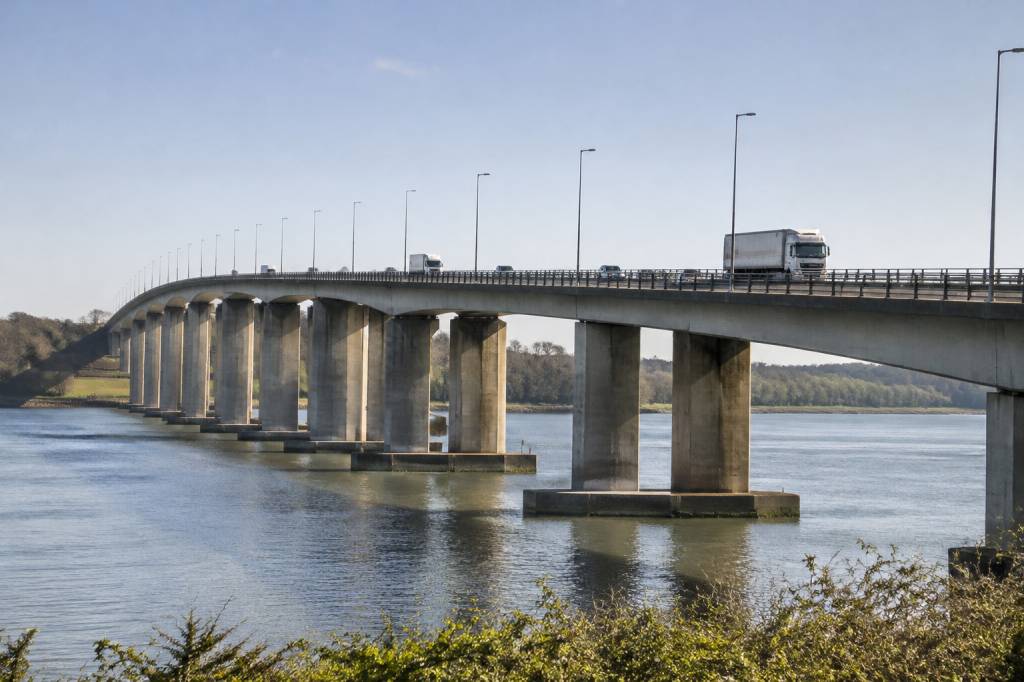
Live status: Orwell Bridge restrictions can change quickly, particularly during severe weather or emergency incidents. This article does not confirm that the bridge is closed now. Before travelling, check National Highways’ live traffic information, Suffolk Constabulary updates and local traffic reports for the latest position.
What drivers need to know
The Orwell Bridge is a key part of Ipswich’s road network, carrying the A14 across the River Orwell and connecting routes to the town, the port and destinations farther east and west. When it closes, the effects can spread quickly: traffic builds on alternative routes, journey times rise and local roads can become congested.
For anyone setting out, the practical question is not only whether the bridge is open. It is whether conditions are likely to change during the journey. A route that is clear when you leave may be affected by a closure, an accident or a diversion before you arrive. Check live updates immediately before departure, and again if your journey is long.
Closures are often associated with strong winds, which can make it unsafe for some vehicles to cross the exposed structure. Other incidents, including collisions or emergency roadworks, can also lead to restrictions. The reason and the length of a closure matter: a short precautionary restriction calls for different planning from a full closure expected to last several hours.
How to check the latest bridge updates
Use official and live sources rather than relying on an old social media post or a navigation app alone. Traffic apps can help identify queues and suggest alternatives, but they may not immediately reflect a new restriction or an official diversion. Check the information against current road-authority or police updates.
- National Highways: Check its live traffic information for the A14, road closures, delays and diversion details.
- Suffolk Constabulary: Look for updates on serious incidents, emergency closures and public safety instructions.
- Local authorities: Suffolk County Council may share information about local-road conditions and planned works.
- Local news: Regional reporting can provide context on disruption, but confirm the current status before travelling.
- Navigation apps: Use these to compare journey times and spot developing congestion, while treating their suggested routes as guidance rather than official diversions.
When checking an update, note its time, the direction affected and whether the bridge is fully closed or subject to restrictions. “Closed” can mean different things in different reports: access may be stopped in both directions, limited to certain vehicles, or reopened after an earlier incident. A timestamp is especially important during fast-changing weather.
Why the Orwell Bridge closes
The bridge is exposed to conditions that can affect high-sided vehicles, including lorries, buses and vehicles towing trailers. Strong crosswinds can make these vehicles harder to control. When wind speeds or forecasts reach a level considered unsafe, authorities may impose restrictions or close the route as a precaution.
That decision can be frustrating, particularly when conditions feel manageable at ground level. But wind strength can vary between locations, and a vehicle that is stable on an ordinary road may be more vulnerable on an exposed crossing. A closure is intended to reduce risk to drivers and other road users, not simply to inconvenience them.
Weather is not the only cause of disruption. A collision can require emergency access, investigation or clearance work. Mechanical problems, road damage and planned maintenance may also affect traffic. The safest response is to follow the instructions in current official updates rather than assume that a familiar closure pattern applies.
What happens when the bridge is shut?
Traffic may be directed away from the crossing using signed diversions. Depending on the location and circumstances, these may involve other sections of the A14 and roads around Ipswich. Diversion routes can be busy, and they are not always the quickest choice for every destination.
Local roads may also take on extra traffic as drivers try to avoid queues or follow routes suggested by their sat-navs. This can affect residents, buses, deliveries and access to businesses. In some cases, a shortcut through town can take longer than remaining on the signed route, especially once several drivers make the same decision.
Do not enter a closed road or ignore traffic-management signs because a navigation app appears to offer a faster route. Police and road crews may need clear access, and unofficial detours can create additional hazards. Follow temporary signs and instructions from traffic officers.
Planning a journey during a closure
If the bridge is closed or restrictions are in place, build extra time into your journey. A few minutes may be enough for a minor delay; a major incident can have a much wider effect. If you have a fixed appointment, tell the person expecting you that you are travelling through an affected area rather than trying to make up time on the road.
- Check before leaving: Review the latest traffic and weather information, including the time each update was issued.
- Choose a route early: Compare official diversions and realistic alternatives before you reach the affected area.
- Allow for changing conditions: Keep an eye on updates if the closure is weather-related or the incident is still being managed.
- Keep fuel or charge in reserve: Slow traffic and detours can extend a journey, particularly for electric vehicles with limited range.
- Carry essentials: For longer trips, water, medication and a charged phone can be useful if you are delayed.
- Drive patiently: Leave space, avoid sudden lane changes and do not use a phone while driving.
If you are already on the A14 when a restriction is announced, do not make a last-minute manoeuvre to escape the queue. Follow road signs and police directions, and use a safe place to stop before checking your phone. A sat-nav recalculating in the middle of a traffic queue is not a reason to take a risky exit.
Advice for drivers of high-sided vehicles
Drivers of lorries, vans, coaches and vehicles towing trailers should pay particular attention to wind-related warnings. Even when the bridge remains open to some traffic, restrictions may apply to specific vehicle types. Check whether your vehicle is affected before approaching the crossing.
If a restriction is in force, do not assume that experience or a short distance makes it safe to continue. Follow the official instructions and use the designated alternative route. Operators should share updates with drivers and allow time for a diversion; dispatching a vehicle towards a likely closure without checking conditions can add avoidable pressure to the network.
Drivers should also be alert to sudden gusts and changes in vehicle stability. If conditions become difficult, slow down safely and avoid abrupt steering or braking. Never stop on the bridge unless instructed by authorities or there is an immediate emergency.
Options for commuters and visitors
Commuters who cross the bridge regularly can reduce the impact of disruption by identifying more than one workable route in advance. That does not mean every alternative will be faster. It means knowing which route is suitable for your destination, vehicle and travel time before traffic becomes heavy.
Where practical, consider adjusting your departure time, working remotely or using public transport. Check with your bus or coach operator before travelling, as services may be delayed or diverted during a major closure. Rail services may offer an alternative for some journeys, but they will not replace every cross-river road trip, and their own live status should be checked.
Visitors heading to Ipswich or the Suffolk coast should plan around the whole journey, not just the bridge. If an event, appointment or accommodation check-in is time-sensitive, leave a larger buffer and keep contact details available. A small amount of preparation can prevent a traffic delay becoming a missed booking or a hurried journey on unfamiliar roads.
Residents and businesses: what to expect
Bridge closures can affect more than through-traffic. Businesses may face late deliveries, staff delays and changes to customer travel plans. Residents on diversion routes may experience heavier traffic and longer waits at junctions. These pressures are often temporary, but they can be significant while a closure remains in place.
Businesses can help by checking updates before arranging time-critical deliveries, informing customers of possible delays and asking drivers to use official routes. Residents should allow extra time for essential trips and be cautious around unfamiliar traffic. Where roads are busy, avoid blocking junctions or stopping in places that obstruct buses and emergency vehicles.
Local communities can share useful information, but posts should distinguish confirmed facts from guesses. If you pass on a closure notice, include its source and timestamp. An outdated message can send drivers towards a route that has reopened—or fail to warn them about a new restriction.
When is the bridge likely to reopen?
There is no single reopening timetable that applies to every closure. For a weather-related restriction, authorities may need to assess conditions before allowing traffic back across. For an incident, reopening can depend on emergency response, vehicle recovery, road inspection and any necessary repairs. A predicted time is not a guarantee.
Look for a clear official update saying that the road has reopened, and check for continuing restrictions or queues. Even after traffic starts moving again, congestion can take time to clear. If you can delay your journey safely, waiting for conditions to settle may be less stressful than joining the first wave of traffic.
A simple checklist before you set off
- Is the Orwell Bridge open in the direction you need?
- Are there vehicle-specific restrictions or a signed diversion?
- When was the latest update published?
- How are weather and traffic conditions likely to change during your journey?
- Have you allowed enough time for congestion and checked a realistic alternative?
The Orwell Bridge is essential infrastructure for Ipswich, so any closure can affect a wide area. The most reliable approach is straightforward: check current official updates, follow signs, and leave enough time to respond safely. When conditions are uncertain, a little patience is more useful than an optimistic sat-nav estimate.