


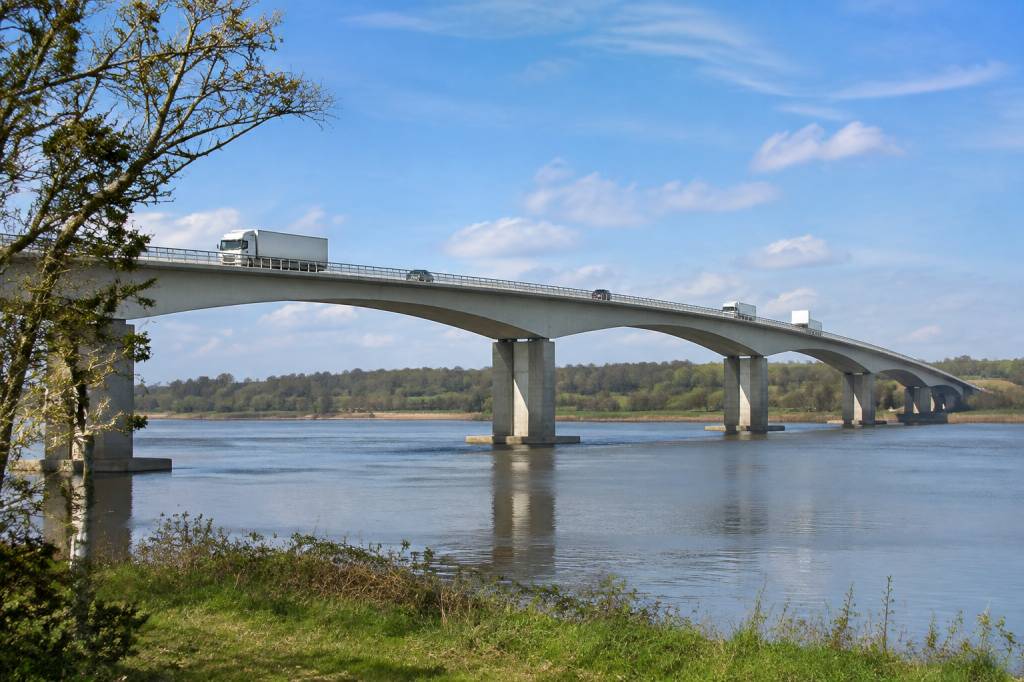
Is the Orwell Bridge open? The bridge’s status can change quickly, particularly when strong winds, collisions or roadworks affect the A14. A report that it was open earlier in the day is not a guarantee that it is open now. Check a live traffic service and official local updates before setting out; this article explains what to look for and how a closure can affect journeys around Ipswich.
How to check the latest Orwell Bridge traffic
The Orwell Bridge carries the A14 across the River Orwell, west of Ipswich. It is a key part of the route between the port, the town and the wider road network, so even a short closure can have consequences beyond the bridge itself. Traffic may back up on the approaches, and delays can spread to surrounding roads.
For a decision you can act on, check more than one current source. Look at live traffic information from National Highways, Suffolk Police, Suffolk County Council and established navigation services. Official channels are especially useful for confirming a closure, its cause and any signed diversion. Navigation apps can help show queues and suggest alternative routes, but their suggested shortcuts may not reflect local restrictions or conditions.
- National Highways: Check for A14 incidents, roadworks and traffic management. The Orwell Bridge is on a major trunk road, so National Highways updates may provide information about closures and operational restrictions.
- Suffolk Police: Look for announcements about serious incidents, emergency response or road closures. Police updates can explain why a road has been shut, though they may not provide continuous traffic reporting.
- Suffolk County Council: Check local travel information for roadworks and disruption on council-managed routes that may form part of a diversion.
- Live navigation services: Use a current map or traffic app to assess congestion and estimated journey times. Treat a route change as guidance, not as an instruction to ignore road signs.
If you are reading this after hearing that the bridge has closed, check the timestamp on the update. An old post can continue circulating after the road has reopened. The same is true in reverse: a closure announced earlier may have been extended because of an investigation, repair or worsening weather.
Why the bridge closes
Strong winds are one of the best-known reasons for restrictions on the Orwell Bridge. The bridge is exposed, and high winds can make driving unsafe, particularly for high-sided vehicles. Depending on the conditions, authorities may impose restrictions before deciding whether a full closure is necessary. Drivers should not assume that a restriction affecting one type of vehicle means every vehicle can proceed; follow the signs and instructions in force.
Weather is not the only cause. A collision, a vehicle breakdown, debris on the carriageway, road damage or an emergency response can all disrupt traffic. Some incidents require a full closure while police or other crews assess the scene. Even after the immediate danger has passed, the road may remain shut while vehicles are recovered, evidence is gathered or the carriageway is inspected.
Planned maintenance can also affect traffic. Work may involve lane restrictions, overnight closures or temporary traffic management rather than a complete shutdown. Details vary by project and date, so check the specific notice before travelling. A routine maintenance closure and an emergency closure may look similar on a map, but they can have different start times, durations and diversion arrangements.
The practical point is simple: do not rely on memory. A route that was clear yesterday may be restricted today, and wind conditions can change during a journey. Check again before leaving if the weather is unsettled or your trip depends on arriving at a particular time.
What happens when the Orwell Bridge is closed?
A closure removes a direct crossing of the river on the A14, leaving traffic to use other roads around Ipswich or travel farther to reach another suitable crossing. The result depends on where a driver is going. A local trip and a long-distance journey may need very different alternatives.
Traffic can build on the roads leading to the bridge as drivers reach the closure point, turn around or follow a diversion. The knock-on effect may reach junctions and local streets, particularly when a large number of drivers are redirected at once. That is why a route that appears shorter on a map can become slow in practice: it may be carrying displaced traffic from the A14 as well as its usual flow.
When a closure is confirmed, use the diversion signed by the authorities. Diversion routes are selected to manage traffic as safely as possible, taking account of road capacity, vehicle types and local conditions. A satnav may suggest smaller roads because they look faster at that moment, but those roads may be unsuitable for heavy vehicles or already congested.
Drivers should also avoid stopping on the approach to photograph a queue or read updates. Pull over only where it is legal and safe to do so. If traffic is stationary, keep clear of junctions, emergency access points and the vehicles ahead. Small decisions matter when a road network is under pressure.
Planning a journey during a closure
If the bridge is closed and your journey is not urgent, delaying departure may be the least stressful option. Check the status again before setting off rather than joining a diversion that is already filling up. For work, medical appointments or time-sensitive travel, allow extra time and tell the person expecting you that conditions may change.
If you do need to travel, plan around your destination, not simply around the bridge. A route that avoids the A14 may still encounter congestion on the roads serving Ipswich. Check for roadworks and incidents along the whole journey, and make sure your navigation app has current traffic data. If you are driving a van, lorry or other large vehicle, pay particular attention to restrictions and signed routes.
- Check the latest official update before leaving and again if conditions worsen.
- Follow temporary signs and instructions from police, traffic officers and road crews.
- Allow more time than your normal journey requires, especially at peak periods.
- Keep fuel, phone battery and essential supplies in mind if you expect a long delay.
- Do not use a phone while driving. Ask a passenger to check updates or stop somewhere safe first.
For people collecting passengers or making a delivery, agree on a backup plan. A clear meeting point away from the immediate closure area can prevent repeated calls and unnecessary trips into congestion. If you are heading to the port or travelling for a scheduled appointment, check directly with the relevant operator or organisation as well as checking the roads.
What drivers should know about wind restrictions
Wind-related restrictions can be confusing because they may change as weather conditions develop. A warning that the bridge is being monitored does not necessarily mean it has closed. Conversely, conditions can deteriorate after a journey begins. Keep an eye on official updates and obey any signs that direct particular vehicles to stop or take another route.
High-sided vehicles are more vulnerable to crosswinds, but other drivers should not treat a restriction as someone else’s problem. Wind can make steering more difficult, especially in an exposed location. Maintain a steady speed appropriate to the conditions, leave extra space and avoid sudden manoeuvres. If officials close the bridge, do not attempt to cross because the road looks passable from a distance.
Weather forecasts can help with planning, but they are not a substitute for a live road update. A forecast describes expected conditions over an area and period; a traffic notice tells you what authorities are doing on a specific road. Check both when strong winds are predicted.
How to tell whether a closure has ended
A closure is not over just because traffic on a map appears to be moving. Mapping services can take time to update, and a line of vehicles may begin moving before the road is fully reopened. Look for a fresh official notice confirming that the bridge has reopened or that restrictions have changed.
Even after reopening, delays can take time to clear. Vehicles held on the approaches must move through the affected section, and traffic that has diverted may still be using surrounding roads. A reopening means access has resumed; it does not necessarily mean the journey is back to normal.
Before turning back towards the A14, check the latest information and follow any temporary arrangements. If your route has already been diverted, it may be safer to continue on the signed diversion than to make a sudden change based on a single map update. Never stop in a live lane or make an unsafe turn to reach a preferred route.
Why reliable updates matter to Ipswich
The bridge is more than a convenient crossing. It supports journeys to and from Ipswich and forms part of the wider A14 corridor, which connects regional traffic with important services and businesses. When it is disrupted, the effects are felt by commuters, delivery drivers, visitors and residents using local roads.
That makes accurate information important. A confident but outdated social media post can send drivers towards a closed road or an unsuitable diversion. A short official update may be less dramatic, but it is more useful when it gives a time, a location, the nature of the restriction and the route drivers should follow.
If you share an update, include its source and the time it was published. Avoid presenting an old photograph or message as proof of current conditions. Road status is time-sensitive, and a few minutes can matter during a fast-moving incident.
Quick answer: is the Orwell Bridge open?
The reliable answer is the one shown by current official traffic information at the time you travel. The bridge’s status can change because of wind, collisions, maintenance or other incidents, so a static article cannot confirm whether it is open at this moment. Check National Highways and local authority or police updates, then follow the signs on the road.
If the bridge is open, leave extra time when weather or traffic conditions are poor. If it is closed, use the signed diversion, consider delaying non-essential travel and check again before setting out. A two-minute status check can save a much longer wait on the approach to Ipswich.